
Note: Before we begin,Don’t worry if you’ve never heard terms like bonds, yields, or yield curves… before. This isn’t a finance lesson. It’s a story about money. And by the end of it, those terms will make sense naturally. You just need curiosity and patience and hunger to learn. Because by the end of this article, you’ll understand why some of the smartest investors on Earth spend their lives watching a market most people never pay attention to.
—
A few months ago, I stumbled upon a question that made me think. A question that made me very uncomfortable.
A question that made me question almost everything in the world.
It was early in the morning, probably around 5:30 AM. I had just woken up from my cozy bed, walked into the living room, and was watching the news with my father.
The news anchor was saying,
“Oil prices have increased from $60 to $80 per barrel.”
“Gold prices are about to touch a record high.”
“This XYZ company is getting sold for billions of dollars.”
And then a thought struck me out of no where.
We know the cost of oil. We know the cost of gold. We know the cost at which a company gets sold. We know the cost of the T-shirt we wear, the phone in our pocket, and the house we dream of buying.
We know the cost of almost anything and everything in the world.
But…
Do we know the cost of money?
Who can be the boss of the FINAL BOSS?
Just think about it.
Money is a tool we use to navigate the world. A tool that can get us almost anything we want. A tool that can make or break nations. A tool that almost every human is working for.
Yet most of us don’t understand it very well.
I realized that I had spent years learning about startups, businesses, investing, markets, and economics.
Yet I had never seriously asked that question.
What is the cost of money?
—
Last year, somewhere in the world,
A startup slowed down its hiring, a family postponed their yearly vacation, governments instructed banks to reduce lending, and millions of people went on with their day without realizing they were all reacting to the exact same thing.
None of them knew each other. None of them spoke to each other. Yet somehow they were all responding to the same invisible force.
The founder called it “market conditions.” The family called it “bad timing.” The government called it “fiscal management.”
Different names, but all were impacted by the same force.
And the strange part is, most people spend their entire lives feeling its effects without ever seeing it.
So I’m asking again,
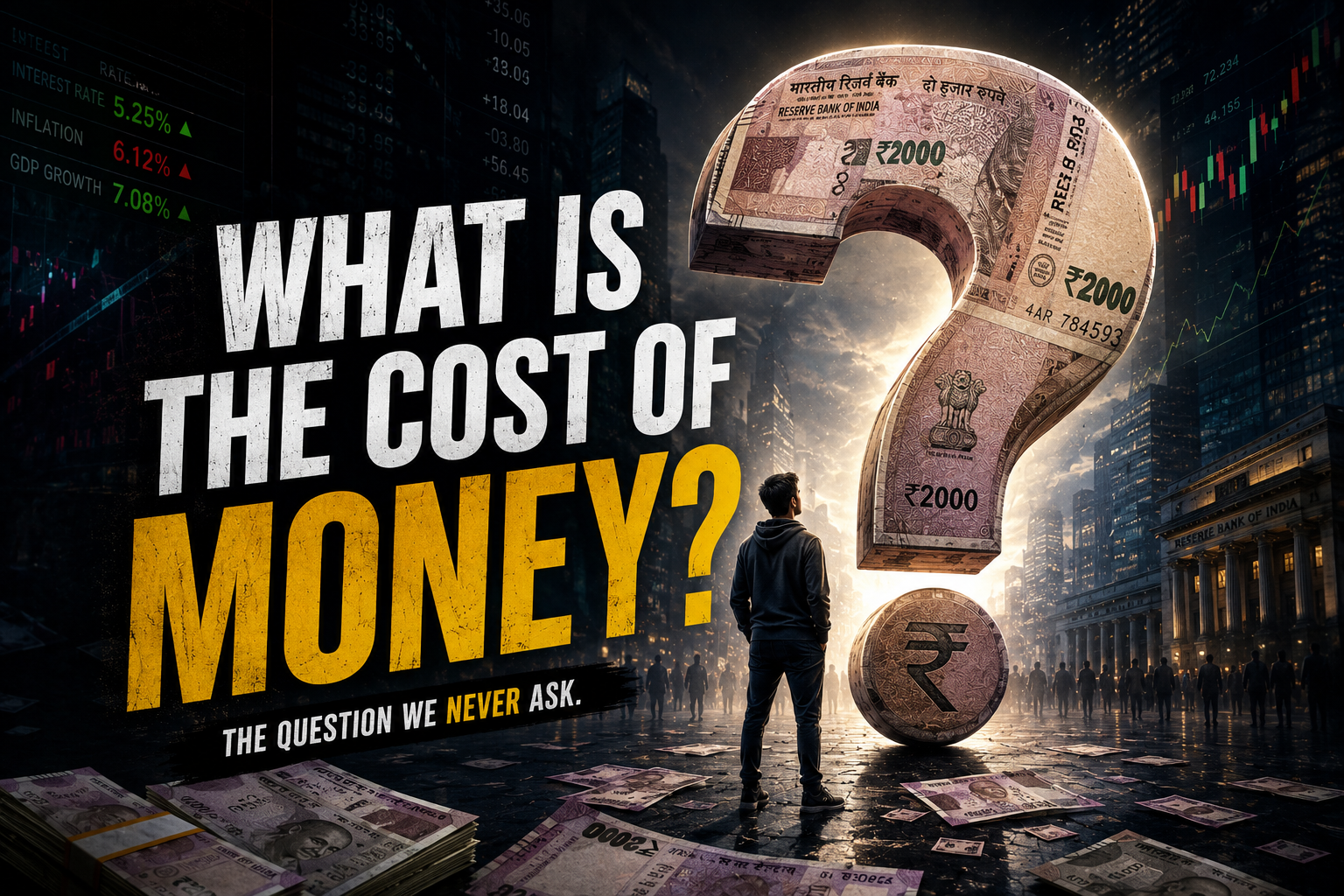
What is the cost of money?
Just understand this.
If you today owned a beautiful 1960s retro gangster car in great condition, how much would you sell it for?
To arrive at a price, you would probably go through a few checkpoints.
- What is the demand for this car today?
- Are similar cars already available in the market?
- Does my car have any unique value? Maybe it was signed by someone famous or previously owned by a celebrity.
- If someone owns this car today, what changes in their life?
- What was the original price of this car?
You would probably add a few more assumptions that matter to you and then come to a conclusion.
Eventually, you would put a price tag on it.
But what are you really doing here? You are trying to understand the value of the car. You are trying to understand what the market thinks that car is worth. So you can sell it for it’s market price.
Think about it.
If you wanted to buy a kilogram of gold, you would have to pay its market price.
If you wanted to buy a barrel of oil, you would have to pay its market price.
If you wanted to buy a house, you would have to pay its market price.
So what is the market price of money? Hmm…
It is “INTEREST“.
Isn’t that obvious? Absolutely.
Interest is simply the cost of money.
Go and ask your parents this.
If they got a home loan at 2% interest, would they be interested in buying?
Even if they weren’t planning to buy a house immediately, they would at least consider it. Because the interest is just 2%.
Now ask them whether they would be interested if the interest rate was 12%.
Most people would reject the idea immediately.
Why?
Because money has become expensive. That’s all.
If you get money at a lower interest rate, it is cheap.
If you get money at a higher interest rate, it is expensive.
As simple as that.
The World’s Largest Negotiation
What if I tell you, everyday there happens a greatest and most important negotiation in the world. A negotiation so important that if it goes wrong, everyone’s life becomes a little harder.
It is not an oil negotiation. It is not a trade agreement. It is not about war.
It is __________.
Okay, we’ll come back to that in a minute. Before that, answer me this.
If interest is the cost of money, who decides what that interest should be?
Why is it 5% in one period and 10% in another?
Why can a startup raise capital effortlessly one year and struggle the next?
Why do home loans suddenly become expensive?
Who is actually deciding this INTEREST RATEEE?
Most people would say,
The central bank, the government. And they are right… to an extent.
But do you really think they are the only ones deciding the price of money?
Let’s go a little deeper.
If they are deciding the interest rate, then on what basis are they making that decision?
Think back to our vintage car example.
What determined its value? Market sentiment.
Demand, Supply, Perception.
The same thing happens with money. The value of money is heavily influenced by what is happening in the economy.
When people BUY, BUY, BUY…
Products get sold faster, demand increases, scarcity follows, prices start rising, inflation kicks in.
So, to slow down that inflation, the interest rates get higher, money becomes expensive and because of which purchasing power reduces
Money becomes expensive, borrowing reduces, spending slows down, the economy cools off.
If the opposite happens, interest rates often fall.
Money becomes cheaper. People borrow more, businesses invest more, the economy gets a push.
So in many ways, the market is constantly sending signals about what the price of money should be. The central bank influences and guides that price through monetary policy.
—
Now let’s come back to the world’s greatest negotiation.
Did you think of an answer?
For every product that is made, there is a buyer and a seller. Money is no different.
Governments need money, companies need money, citizens need money, startups need money, and on the other side, there are entities that have money.
Investors have money, banks have money, pension funds have money, big institutions have money.
Every single day, these two sides negotiate.
Borrowers want money at the lowest possible cost.
Lenders want the highest possible return.
And both sides are constantly asking the same question. What is money worth today?
That negotiation happens every day, across banks, bond markets, governments, startups, and financial institutions around the world quietly. It is invisible to most people, yet it influences almost everything around us.
Your home loan, your startup funding, job market, investments, economy.
All because of one simple question:
What is the price of money?
And perhaps more importantly…
What will money be worth tomorrow?
Because the answer to that question determines how much a lender is willing to lend, how much a borrower is willing to pay, and ultimately, where the price of money settles.
How do countries borrow?
Imagine tomorrow morning the Government of India announces:
A high-speed rail line, a new defense manufacturing corridor, an AI research hub, a state-of-the-art sports complex, hundreds of kilometers of new highways.
You’d probably think:
“That’s great. The country is developing.”
But there’s a question hiding underneath all of it.
Who’s paying for all this?
The obvious answer is taxes.
After all, every year millions of Indians pay income tax, GST, corporate tax and countless other taxes.
Surely that’s enough. But then you look at the scale.
A country of more than 140 crore people. Thousands of ongoing projects. Need to take care of Salaries, Pensions, Defense, Healthcare, Infrastructure, Education, Future investments….
Only 4% of our country’s population pay tax. How many projects can you build with this money and run the country at the same time?
And suddenly you realize something. Taxes help run a country, but they rarely build its future, because the future is expensive.
Much more expensive than most people imagine. Which raises another question.
If taxes aren’t enough, where does the rest of the money come from? The answer is surprisingly simple.
The government borrows it. Not from one bank, not from a billionaire, not from a secret vault somewhere, but primarily from anyone willing to lend.
And in return, it makes a promise.
“Give me your money today, and I’ll return it later with interest.” That promise has a name.
It’s called a BOND.
At first glance, a bond looks boring. A piece of paper, a contract, a loan.
But the deeper I went, the more I realized that some of the world’s biggest airports, highways, rail networks, ports, and public projects exist because millions of people believed in those promises.
Modern economies weren’t built on cash.
They were built on promises.
Promises made by governments. Promises made by corporations. Promises made by institutions.
Promises that someone, somewhere, would return the money with interest.
And that simple promise became one of the most important turnarounds in modern finance.
But Bonds Aren’t Just About Loans:
At least that’s what I thought in the beginning.
If a country needs money, Investors lend it.
The country pays interest and its the End of story.
Very very simple.
But the deeper I went, the stranger things became.
Because if bonds were really just loans, nobody would obsess over them. Economists wouldn’t spend decades studying them, Governments wouldn’t track them, and some of the smartest investors in the world certainly wouldn’t wake up every morning wondering where bond yields are headed.
Clearly, there was something I wasn’t seeing.
People don’t buy a 10-year bond because they’re excited about collecting interest.
They’re buying a view of the future. Think about it.
If I ask you to lend me money for the next 10 years at an X% interest, what’s the first thing you’ll think about?
About The future.
Will inflation rise?
Will the economy grow?
Will interest rates go up?
Will better opportunities appear elsewhere?
Will the money I return to you ten years from now be worth the same?
Suddenly, the bond isn’t just a loan anymore. It’s a prediction.
A prediction about what tomorrow might look like. And that’s when I realized something fascinating.
Bond prices are rarely about today. They’re about tomorrow.
Every bond bought today is an opinion about the future. Every yield is an expectation about the future. Every movement in the bond market is millions of investors collectively answering the same question:
“What do we think tomorrow looks like?”
If investors believe inflation will rise, they’ll demand higher returns.
If they believe growth will slow down, they’ll start moving towards safety.
If they think interest rates will fall in the future, they’ll position themselves accordingly.
Every decision leaves a footprint. And when millions of investors do this simultaneously, something fascinating happens. The bond market starts speaking.
When Tomorrow Starts Looking Scary:
By now, I had understood one thing.
Bond markets don’t just trade money. They trade expectations. Every yield is a prediction. Every investor is placing a bet on the future.
And that’s when I came across something strange.
Something that, at first glance, made absolutely no sense.
Imagine I gave you two choices.
Option 1:
You lend me money for 2 years and I’ll pay you 5% interest.
Option 2:
You lend me money for 10 years and I’ll pay you 8% interest.
Both the options sound fair enough. Because, the longer your money is locked away, the greater the reward should be.
After all, ten years is a long time.
Inflation could rise. The economy could change. New opportunities could appear.
You deserve to be compensated for waiting.
Now let me shift the scenario.
Imagine this
Option 1:
You lend me for 2 years and I’ll pay you 5% interest.
Option 2:
You lend me for 10 years and I’ll pay you 4% interest.
Suddenly the logic breaks.
Why would anyone willingly lock their money away for a longer period and accept a lower return?
At first, it sounds irrational. But it isn’t.
Think about what kind of investor would make that choice.
Do you think an investor who is hopeful for the future takes that kind of choice? Absolutely not.
Do you think someone who thinks the economy is about to accelerate would take that kind of choice? Hell no.
Then who the hell in the world declines 5% interest in 2 years, and accept 4% interest after 10 years?
It is the one that is worried.
Someone who believes the future might be weaker than the present. Someone who values certainty more than returns.
And when millions of investors start thinking that way at the same time, something remarkable happens.
Let me explain you through some math.
Most people you would instantly choose the first option.
After all, 5% is greater than 4%.
More interest is better, right? Not always.
Let’s see why.
If you choose the 2-year option, invest 1 lakh over 5% return, you’ll earn ₹5,000 every year.
Over 2 years, that’s ₹10,000 in interest.
At the end of the term, you’ll receive:
₹1,10,000
Now let’s look at the 10-year option. You invest 1 lakh over 4% return, You’ll earn ₹4,000 every year.
Over 10 years, that’s ₹40,000 in interest.
At maturity, you’ll receive:
₹1,40,000
At first glance, you might have a straight up question.
What’s the difference between the 1,10,000 I receive in 2 years and 1,40,000 I receive in 10 years, because if you adjust them with inflation, the 1,40,000 might worth lesser than 1,10,000. Yes you are right.
But that’s not how bond investors think.
Because the real question isn’t: “Which bond pays more?”
The real question is: “What happens after the bond ends?”
Suppose you choose the 2-year bond.
After 2 years, you get back your ₹1,10,000. Now you need to reinvest it somewhere.
But what if interest rates have fallen?
What if the best bond available now only pays 1%?
Suddenly, your attractive 5% deal is gone.
You are forced to settle for a much lower return.
This is where the 10-year bond becomes interesting.
Even though it pays only 4%, it gives you something valuable: That is certainty.
You have locked in that 4% return for an entire decade. No matter what happens to interest rates tomorrow, next year, or five years from now, you’re still earning 4%.
And that’s exactly why investors buy long-term bonds with lower yields.
They’re not looking at today’s interest. They’re looking at tomorrow’s.
When investors expect the economy to slow down, they also expect central banks to cut interest rates.
And if rates fall in the future, today’s 4% suddenly starts looking very attractive. So investors rush to buy long-term bonds. As demand rises, bond prices rise. And when bond prices rise, yields fall.
That’s why economists pay close attention to long-term bond yields. Because they’re not just numbers. They’re predictions.
Every bond investor is making a statement about the future.
A 2-year bond is essentially a bet on the next two years.
A 10-year bond is a bet on the next decade.
And when investors are willing to accept a lower return for a longer period of time, they’re often telling us something important:
Tomorrow doesn’t look as good as today.
That’s why the bond market is often called the market that trades tomorrow.
The Whisper Beneath The Economy
At this point, I finally understood why investors obsess over bonds. But there is still one question bothering me.
Why should the rest of us care?
After all, most people don’t buy government bonds. Most people aren’t managing billion-dollar portfolios. Most people have never even looked at a bond yield chart.
So why does any of this matter?
Because bond markets don’t stay inside bond markets. Their effects leak into everything else.
A simple example: If a government bond is returning 7% interest, why would anyone lend their money elsewhere for 5%? Investors naturally chase higher returns. To attract that money, other institutions must offer a similar or higher rate. In a way, government bond yields become the benchmark for the entire market.
Imagine bond yields start rising.
Higher bond yields usually mean borrowing money becomes more expensive.
Businesses think twice before taking loans, startups find it harder to raise capital, families postpone buying homes, governments spend more money servicing debt, expansion plans get delayed, hiring slows down, spending slows down, growth slows down.
Now imagine the opposite.
Bond yields begin falling.
Money becomes cheaper, borrowing becomes easier, businesses become more confident, Investors become more willing to take risks, growth accelerates.
The point is simple.
A movement in the bond market isn’t just a movement in the bond market.
It’s a ripple. And that ripple eventually reaches everyone.
The founder trying to build a company, the family trying to buy a home the student applying for an education loan the government building infrastructure, the investor searching for opportunities.
Most people never see the ripple begin.
They only feel the wave when it reaches them.
The Answer to the Question:
A few centuries ago, if a king wanted to build an empire, he needed gold.
Today, if a nation wants to build its future, it needs something else. Belief.
Belief that roads will be used.
Belief that businesses will grow.
Belief that taxes will be collected.
Belief that tomorrow will be better than today.
Strip away all the complexity, and that’s what a bond really is. A transfer of belief from one person to another.
Someone says:
“I believe the future will be strong enough for this promise to be kept.”
And someone else accepts that promise.
That’s it. That’s the entire game.
The fascinating part is that every bond issued, every bond bought, and every bond sold is really answering the same question:
“What do we think tomorrow looks like?” Because every interest rate contains an expectation. Every yield contains an opinion. Every bond price contains a story about the future.
And when millions of people make those decisions together, the future gets a price tag. Which brings us back to the question that started this entire journey.
What is the cost of money? Maybe that’s the wrong question. Maybe the better question is:
What is the cost of uncertainty? Because that’s what bond investors are really trying to figure out.
How much should I be paid for trusting the future? And perhaps that’s why bond markets matter so much.
Not because they’re about loans, governments, or interest rates. But because they’re one of the few places where humanity collectively tries to put a price on tomorrow.
And whether we realize it or not, everything else follows.
Everything is priced by tomorrow.
—
Pass it Forward
If this article made you think differently, send it to someone who is trying to grow in life.
Who knows, your one little share can change the trajectory of their life.
Also, most people spend their lives watching things happening in financial, personal and business world.
A few spend time understanding, and take actions towards it.
If you are one of them, then welcome to the club buddy. Welcome to thehustleweek.
See you next sunday, Bubyee